

We’ve all seen the stats that e-commerce is leaping. Many of us buy toothbrushes online these days! And why not? It’s quick, we don’t have to drive to a store, and we can do it anytime.
While that’s undeniably true of consumer purchases, is it also the case for business buying? That’s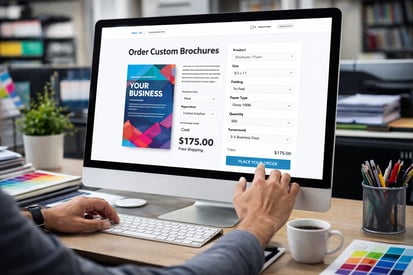 the question for any printer considering developing an e-commerce site. Broadly speaking, e-commerce may not be a fit for all markets. But when you consider that most print buyers today have been raised on digital interactions, it’s safe to say printers will benefit from some form of online functionality with a B2B portal.
A B2B portal is a secure, self-service online platform where clients can manage their transactions with you. A well-constructed e-commerce site will accommodate several clients with individual secure logins. Each customer portal will reflect the particulars of that client—products, substrates used, design templates, pricing, order tracking, delivery timelines, purchase history, inventory levels, and so on. Estimates, order intake, proofing, and shipping information will be common functions. Other functions include protocols for user permissions, ensuring only authorized users can access the portal.
B2B portals can work for all clients, but if your customers place regular repeat orders, have multiple sites, or large marketing teams that need consistent broad branding with local customization, then e-commerce will provide real value.
Benefits
Implementing e-commerce requires time and resources, but the benefits can be substantial. First, it caters to what clients want with greater convenience, anytime, anywhere access, and faster service. Internally, online buying will streamline your operations: estimators can focus on large complex orders, sales reps will gain time to focus on customer relationships, and automated proofing reduces bottlenecks. There’s no manual data entry and you can handle more individual sales without staffing up.
E-commerce can also cement your relationship with a client, and not just because of the added convenience. Transitioning to digital transactions is an investment of time on their part too. Moving on to a competitor becomes a much more complicated process, one most clients will not be keen to attempt.
Challenges
A conversion to online commerce comes with some challenges, but they are almost always worth the effort. Since a proper e-commerce site must integrate will all areas of the business, from estimating to warehousing and shipping, it will take time to identify the parameters for each department.
Customizing the content for each client can also be time-consuming, with individual product catalogs, pricing structures, and so on—depending on your client mix.
Integrating with other systems, such as MIS, ERP, and other workflows, are tasks that require some attention. The process may not always go smoothly. Likewise is the task of maintaining the relevant databases these systems need to function.
Data protection and security are always key considerations, especially when dealing with critical client information.
Develop or Buy
A key consideration for e-commerce, as for most software, is whether to purchase a ready-built system from an OEM or build your own.
Anyone who has struggled with over-promises and under-deliveries from OEMs will be tempted to go their own route. If you have the technical expertise in-house and the time, or can call on a trusted third party, going it alone is an option. It gives you control over the entire solution. Since you know your processes best, it may be easier to customize a system for your unique needs.
The OEM route, particularly if you already have a tech stack you have carefully built from suppliers, may save you some headaches. Developers have already considered and built in the necessary functionalities and features. If an OEM has a large client base, it will have learned lessons and gained experience that can make implementation go more easily.
Many also feature scalable options, so you can start small and build as your needs increase.
System maintenance isn’t an issue, since the software vendors will automatically update the platforms. Most OEMs provide troubleshooting resources, and if your tech expert leaves, you won’t face a severe knowledge gap.
Taking the e-commerce plunge is no different from other investments. It takes research, defining clear goals, and a careful assessment of what clients need. When you consider that most print buyers today are used to the easy efficiency of ordering toothbrushes from Amazon, giving them the same convenience when buying from you is an investment worth making.