

Eco-friendly practices are increasingly prized by clients, which means all print shops should address what they’re doing to enhance sustainability. But be honest about what you’re doing. Most clients can also sense greenwashing and may punish you for being deceptive or attempting to hide the facts.
If you present a strong narrative, you must be prepared to prove it. If your sustainability efforts are still a work in progress, be honest about it. Communicate a viable sustainable story centered on items like materials, energy usage, certifications, and verifiable metrics.
The most obvious place to start is to make sure you adhere to all local, state, and national laws and regulations that apply to your operation. You can’t boast about being sustainable if you get slapped with a fine.
Choose Materials and Inks That Support the Story
As much as possible, offer your clients materials that are better for the environment, including recycled and compostable items. Both are important. You don’t want to use recycled inputs if they aren’t compostable or recyclable themselves.
Use recycled paper when you can or opt for paper from responsibly managed forests, certified by organizations such as the Forest Stewardship Council (FSC). Certification can be a painstaking process, but it clearly sends a signal to clients that you care.
Beyond the paper you print on, consider the packaging and shipping materials you use, and choose biodegradable or recyclable options as much as possible. Make sure the recycling instructions are clearly visible. And look at other sustainable substrates for printing jobs.
Traditional petroleum-based inks contain volatile organic compounds (VOCs) that can harm the environment and humans. Soy-based or vegetable-based inks can reduce VOCs and may be easier to recycle. LED inks may be another option to reduce VOCs. Talk to your supplier about using refillable toner or ink cartridges. You may need to educate your clients about why the right ink and how it is delivered is an important environmental choice.
Reduce Waste Through Digital Production
Adopting a digital print-on-demand business model delivers substantial sustainable benefits that include less waste in bringing the press up to production speed, a more efficient prepress function without plates, and no overages that may potentially be destroyed. You’ll also reduce the climate control measures required for material inventory, significantly reduce the chances of producing obsolete matter, and reduce emissions.
Many software packages, like MIS systems, asset management, remote proofing, workflow systems that streamline production, and imposition software that can reduce paper usage can help lessen energy and waste. You can make a similar case for opting into remote equipment diagnostics and support. There is no point bringing techs to your shop if they can fix your devices remotely.
Investments in color management platforms can have an environmental angle as well. Consistently monitoring color accuracy reduces rework and the extra paper, ink, and energy consumption that often goes with it.
Lower Your Energy Use and Recycle
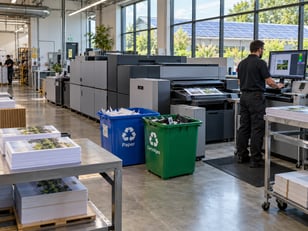 Purchase or lease devices that meet Energy Star certification, and if your devices have an energy saving mode, use it. Invest in modern, energy-efficient printers and presses that consume less electricity. Regular maintenance and calibration keep them running at peak efficiency, preventing energy waste.
Optimize heating, ventilation, and air conditioning systems to lower energy consumption and carbon emissions. As an alternative, consider renewable energy sources such as solar or wind power and investigate any government rebates.
Implementing comprehensive recycling programs throughout your business can decrease waste. Encourage your staff to recycle as much as possible, including in kitchen areas, personal offices, and other non-production spaces.
Measure Progress, Share Results
No matter where you are on the sustainable journey, you can always benefit from an environmental audit to find gaps and areas for improvement. Also consider investigating and adopting an environmental and carbon footprint calculator. Many such products track usage and provide feedback to reduce emissions and energy consumption. You might install a calculator on your website so customers can see not only how your shop performs, but how their jobs stack up.
Sustainability, like all other business strategies, must be communicated consistently and repeatedly to all existing clients and those you hope to sign as customers. But most crucially, your story must be truthful.